


Tagged: compressor, dynamic range, eq, equilizers, headphones, imager, limiter, mix-feedback, multi-band, Ozone, piano, stereo audio track, stereo image, trim plugin, upright piano
-
Mix Feedback Solo Piano
Posted by Patrick Harber on at 3:11 pmHi,
Any tips to make this better?
Thanks,
Dana Nielsen replied 1 year, 4 months ago 5 Members · 42 Replies -
42 Replies
-

Patrick, I think the performance outperforms the capture. The first thing we hear is the low frequency thumping of the foot pedals and the low frequency of the ( I’m guessing ) HVAC system or traffic noise leaking into your recording environment. The focus should be on the piano, not the external and a high pass filter would help the cause by filtering out the lowest frequencies and allowing (passing) the higher sounds. Having a speaker system or headphones that are closer to full range would allow you to hear these unnecessary and invading low freqs. Listening on the laptop will not work for critical listening. There’s a pretty big buildup of low mids also, almost approaching a honky-tonk upright but without tonk, and by that I mean the percussive tack sound of strings being hit. Sounds like you have a pair of mics on there. That certainly gives the piano more space and a wider sound-field than a single mic capture would. Experimenting with different mic placement may result in a more natural sounding recording. Give it another go and let’s see what you can improve upon. PT
-

Great advice, Paul, on the detailed headphone listening – always a smart move and great for catching those pesky rumbles and unwanted ambient sounds. I hadn’t noticed these things on my studio speakers at low volume, but that’s also why headphones are such a helpful microscopic/QC check! 🎧
-
-
Patrick! Welcome, man! I know you’ve been here a while but stoked you decided to share this audio with the community for some creative feedback and ideas. 🙌
Love the piece and the playing and I really dig the sound of this piano – it’s an upright, right? I’m also curious how you mic’ed it as there are so many fun (and sometimes daunting) ways to mic an upright. Just curious – I think you did a nice job keeping things in phase and capturing the stereo width.
My main thoughts are:
- The mix feels overly loud, overly compressed. I would try dialing the compressor and/or limiter back a good bit so that you have a healthy “appropriately loud for a piano” signal, but without audible compression and set your mastering limiter (if using) so that your master fader meters still show a nice amount of movement (i.e. dynamic range).
- Feels a bit left-heavy. This may be due to the range of the performance (hands were playing in the center-left portion of the keyboard), and that all makes sense and nothing wrong with that, especially if the song/performance moves around into the higher (right side) of the keyboard at some point so things feel balanced by the end of the piece. If, however, the whole solo piano performance stays in that center-left part of the keyboard and there are no additional overdubs added to fill out the rest of the stereo spectrum, I’d typically be inclined to turn up the right channel (or turn down the left) until I’m generally getting an equal volume out of the left and right speakers respectively. That way as a listener I don’t end up feeling fatigued in one ear, or off-balance somehow. These are personal creative philosophical decisions tho, and certainly a case could be made that “no, man, I want the recording to represent the natural stereo state of the instrument as it was played!” and that’s cool too.
- Tonally, i think there’s room to add a good bit of top end. Try a simple, broadband, Pultec EQP-1A (or similar) 10k boost and see if you can bring out some of the shimmer-y sparkly top end.
I look forward to hearing how this mix develops! Keep it up, man!! ⚡️
-

Thanks for the feedback. This was my first time mic’ing an upright piano or any piano. Basically put them on the left and right corners and turned the mics down really low because the piano was so loud. I will check the lows and add some 10k too. Thanks. I’m hoping to add more songs too.
-
Patrick, So what is your recording a piano set up? Directly into the computer mic input or a 4 channel mixer?? Have you got tone control before the recording software? Your “I turned the mics down because the piano was so loud” has me wondering. PT
-
UAD apollo. I used two tlm 102’s. I don’t think I had any processing going into the daw.
-
-
-
-
Nice, @Pat! This is sounding clearer, cleaner, less compressed, and less “loud”. Nice work!
I think you could still bring up the right-channel fader to even out the stereo image so that the volume is more or less equal coming out of the left speaker and the right speaker. (Right now I feel like the balance is left-heavy).
Here are two ways I address left-right balance issues on stereo sources like pianos or drum overheads:
- Adjust gain using a fader: if you recorded your piano onto two mono tracks, one for the mic on the left side and one mic for the right, then you can simply push the Right channel fader up to make the right side louder.
- Adjust gain using a mono Trim plugin: if you recorded your piano into your DAW using a single “stereo audio track” you might be scratching your head like, “but Dana… there’s only ONE PIANO FADER!” 🎚️🤔 If you’re using Pro Tools, just add a mono Trim plugin and unlink the left and right channels within the plugin so you can adjust each channel independently. Pro Tip: This is also a great way for flipping the polarity (i.e. “phase”) between the left and right channels of a stereo track.

-
-
right hand / treble feels a bit quieter to me than the left hand / bass. Which, again, is totally fine if your intent was to set your L/R mic pres at a matched level to capture the instrument exactly as it was played in the room (this performance naturally has more left hand / bass action going on than right hand / treble stuff, so it makes sense that it’s playing back left-heavy). But as a personal preference when it’s solo piano with no additional instruments, I tend to work toward an even Left/Right balance for the listener. These are preferences are purely philosophical tho, and there are no “right” answers, so feel free to disregard and go with your gut!
-
-
Patrick, Now your piano sounds more like this pictured piano except black and white. Definitely go the right vibe tonally and with the wear and tear of the piano.
-
Thanks. That’s pretty much the whole feel. I have a few more of these types of songs. Do you produce as well as mix? I’m looking for someone to help me record all my songs.
-
Patrick, I must have missed this post earlier. Do I produce? Not exactly. I’m semi retired from my career in live audio where I mixed some bands all over the place. Traveled enough to get my million miles in. You know that nearly 50% of men who think they could land the plane in an emergency?? That’s how I feel about producing. I am happy to share my perspective here at Mix Protagonist. PT
-
-
-

Hi Patrick!
Just wanted to say I enjoyed the piece, performance, and I dig how “real” the piano sounds. So organic and full of vibe – which is refreshing!
Looking forward to hearing more!
Best,
Jesse
-
Agreed. I swear I can sometimes hear the cracks in the sounding board. PT
-
-
-

I don’t know a whole lot about this genre but it’s definitely feeling good, the piano is sounding alive, and that’s special these days, so whatever you’re doing with this, it’s sounding cool
-
I have two more clips if anyone has any feedback. Thanks.
-
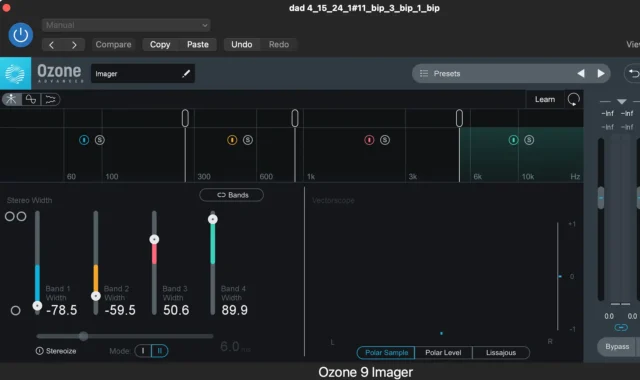
Patrick, I think this piano has a whole lotta joy just trying to bust out and tell stories; much like a precocious kid with undiagnosed ADHD. There’s undeniable infectious enthusiasm presented by the sound of the piano, the song choice, and your playing. It’s a strong character. To help that “Voice” speak more clearly, I did a little EQ. A high pass filter, two cuts, and a high shelf as shown in the attached screen shot. To my ear, that cleaned up the low end and allowed the piano to speak more articulately without crossing over into unnaturally bright for an old time piano. The biggest improvement occurred when I tamed the big S T E R E O S P R E A D that your mic placement caused. I mono-ed everything below 1K ish but kept your hard panning intact to leave some tasteful width. I have an ‘Imager” plug in that made quick work of that. The piano now speaks with a focused voice and is a more transparent storyteller because of these changes to my ear. Some Mid-Side micing voodoo might get you there also. I’ll leave that discussion to others. -PT
-
-
Paul! Thanks for the great comments and ideas!
Would you mind re-uploading your EQ image when you have a chance? Looks like for some reason it’s not showing on my end. 🎛️
-
Yes, I will repost the screenshot. I wrestled with getting that to save as an appropriate file format and lost. Fortunately I saved the DAW session so it is available.
PT
-
-
-
Thanks, Paul. I took a bit of mid out, but I guess I needed more. I also liked your panning. I will try to mono under 1k. Not sure what tool I have than can do that. Not very experienced mid-side mixing but I will try. Also, I recorded a friend playing piano. this isn’t me playing. I wish.
-
Yea man, attached is the URL to the tool I used though this free version is not frequency sensitive as is the paid version. First one is always free….
PT
https://www.izotope.com/en/products/ozone-imager.html
-
Thanks, I have ozone imager. Guess I don’t know how to use it. Mid side is an unexplored technique for me. I don’t know which frequencies should be mono or stereo and then compressed. Need @dana to make a video on that
-
Ooh, good idea for a video! Hearing and identifying mid-side issues is one of those tricky things to wrap your ears around, much like “hearing” compression or identifying phase anomalies.
I’ll add that to my video list!
-
-
-
-
-
Patrick.
Below are the audio file and a screenshot of the EQ applied to the track. As you listen to the before and after, note the overall tone of the piano. Losing the low mid muck and adding some clarity changes everything. Drastically. The clarity and a sense of openess add happy.
And you thought it was just an EQ tool!
Narrowing the stereo spread to a realistic width as presented here would allow you to place it in a discrete spot within an ensemble setting if that is the vision, or at the very least, prevent the piano from slovenly occupying the entire sonic width.
You a Star Wars fan? Remember that scene when Princess Leia was held captive by Jabba the Hut? Yea, you got the picture?
Use the force for good.
PT
-
Ooh, this sounds nice, Paul! Thanks for the screenshot too. And for the use of the word “slovenly.” 🏆👏
-
Hi Patrick! Agreeing with @-PT about the joy and spirit in both your playing, composing, and the piano itself. Removing that “mud” with the EQ really helped the presentation to my ears. I also wonder if a little transparent compression might also benefit the sound. It’s SO dynamic, and I know that a lot of the vibe and spirit are coming from your dynamic performance, but I wonder if a touch of compression might smooth it out just a bit! I’ll let the pros weigh in on that though! Such great stuff man! Keep em coming!
Best,
Jesse
-
-
Love these new piano pieces, Patrick! Thanks so much for sharing. I’m traveling this week so am only listening on my laptop. I can weigh in once I’m back in the studio next week with any specific sonic ideas. Meantime it’s sounding cool! Such a fun vibe that piano has. And, as Paul mentioned, you have a great spirit in your playing and writing!
-
So i messed around with the imager from ozone. i definitely got it cleaner. what do you think about these parameters?
-
Patrick,
Congrats, you and your old time piano are getting rave reviews and 40 something replies at this point! Re: the Imager module… I recall doing something very similar with the controls. I believe I took the sub 100 Hz to complete mono (all the way down on the control slider,) halfway ish down on the low mid, almost full up on the upper mid, and finally, back to normal on the tippy top band.
I was out on my motorcycle earlier this month in Austin, Nevada. It’s an old mining town with some period architecture. Straight outta the Ponderosa. I was hoping to see Ben Cartwright in the saloon I stopped at to have lunch. Apparently, he’s dead but the piano sitting in the corner was talking to me. Sounded exactly like your playing.
PT
-
-
-
-
-
Sweet, Patrick! These are sounding great on my laptop, albeit not the best playback system to really analyze stereo image. That said, on the laptop these sound clear and lively and are a lot of fun to listen to (lifted my spirits, man!). I’ll take a listen on my studio speakers for the stereo image soon.
I’ve been using that ozone imager more and more lately as well – super useful and easy to use, love it!
-
Here’s another that I did. Low end is all over the place. Not sure how to make it better though.
-
Also used the little labs ibp phase tool. Just put it it on one of the tracks. didn’t make sense to put it on both tracks…but maybe. any tips for that tool would be appreciated thanks.
-
Yeah your instincts are correct: put IBP on one of the two tracks so you can sweep around the delay and phase knobs to find a setting that brings the piano “into focus”, especially the low end and low-mids, which is where you’ll likely hear the biggest effects of this IBP knob twirling.
That said, I find that upright pianos are always a bit of an untamable beast when trying to find the perfect full-frequency phase alignment between two or more close mics. I attribute this to the fact that the strings on the soundboard criss-cross: low strings running diagonally in one direction, hi strings diagonally in the opposite direction overtop the low strings. So I’ve found stereo close-mic’ing an upright seldom results in perfect phase results across the whole frequency spectrum. You might sweep the IBP and get a perfect result in the low register but find that setting isn’t great for the mid-range.
So … with that in mind, what I love about the IBP is I can sweep around and tailor the L/R phase and time alignment to suit the song, giving preference to frequencies (i.e., notes on the keyboard) that are prominent in the arrangement and/or essential to the song or mix. For example: who cares that the stereo piano mics are perfectly aligned and in phase for the lowest notes of the instrument if those notes are never played in this song? If a tree falls and no ones is there to hear it, does it make a sound?
Know what I mean? I hope I’m making sense, Patrick!
-
-
-
Log in to reply.